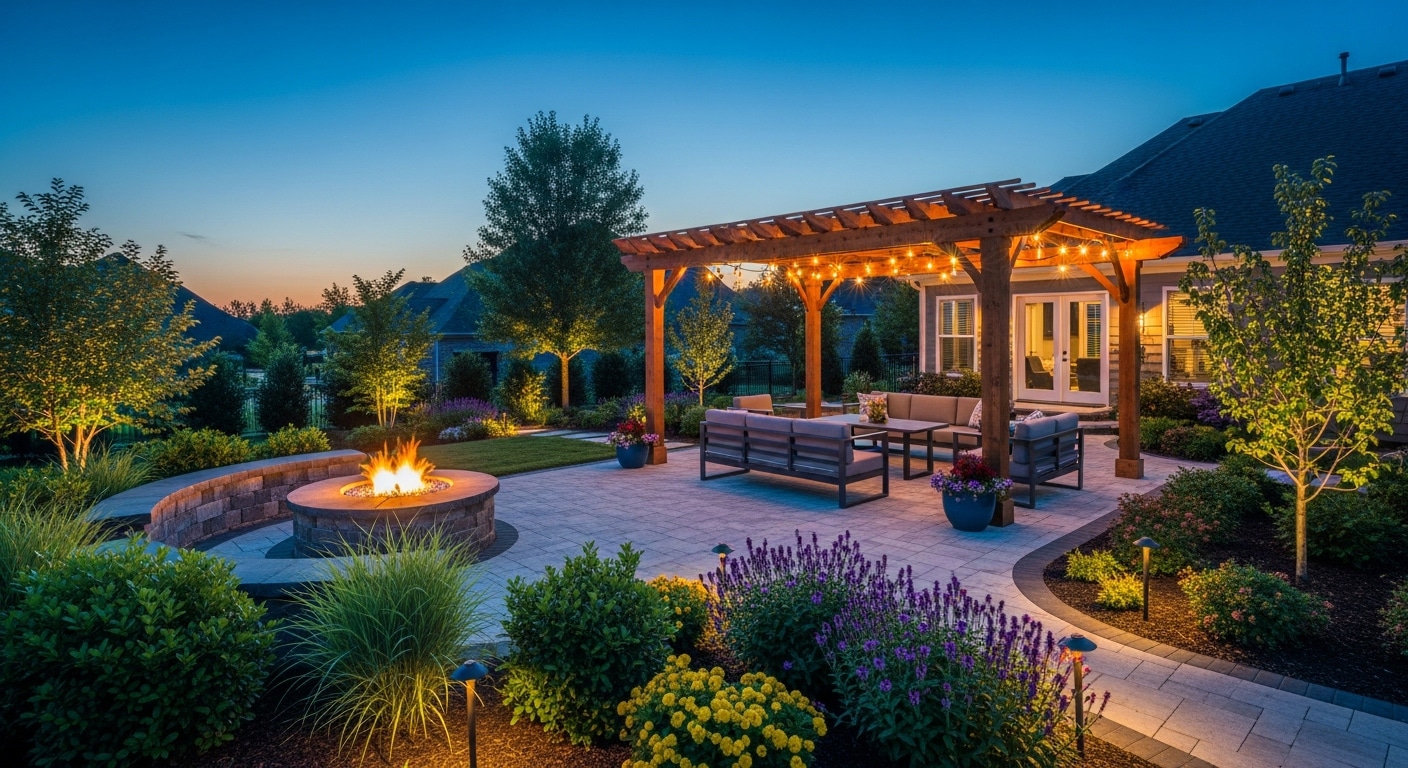
The choice between a gable roof and a hip roof for a Tulsa covered patio is primarily an architectural decision — which roof form makes the covered patio structure look like it belongs with the existing house — with secondary implications for cost, ceiling height, and how the structure attaches to the home. VistaScapes & Design builds both gable and hip roof covered patios throughout Tulsa and Broken Arrow and helps homeowners choose the configuration that best complements their home’s existing architecture.
Gable Roof Covered Patios
A gable roof covered patio has two sloping roof planes that meet at a ridge along the center of the structure, with the triangular gable end visible at one or both ends of the covered patio. Gable roofs are the standard form for most residential construction in Tulsa — if your home has a gabled roofline, a gable roof covered patio typically reads as the most natural architectural extension of the home’s existing character. Gable roofs provide slightly more internal volume at the ridge than hip roofs of comparable pitch, which can make the covered patio feel taller at the center even when the eave height is the same. From a construction standpoint, a gable roof attached to the house at one end (with the free-standing gable end at the patio perimeter) is a common and relatively straightforward configuration. Free-standing gable structures with gabled ends at both front and back are also common for larger covered patio footprints set away from the house.
Hip Roof Covered Patios
A hip roof covered patio has four sloping planes — one on each side of the structure — that meet at a central ridge or peak. Hip roofs have no exposed vertical gable end, which creates a lower visual profile and a more horizontal character that suits certain home styles better than a gable — particularly contemporary homes, ranch-style homes, and homes with low-profile hip or mansard rooflines of their own. Hip roofs shed wind more evenly than gable roofs because there is no vertical gable end to catch wind load — a consideration for covered patios in exposed locations where Oklahoma’s wind events create lateral load on vertical gable faces. Hip roofs are generally slightly more expensive to frame than gable roofs of equivalent size because the hip rafter geometry requires more complex cutting and more individual rafter pieces. The visual result, when it matches the home’s architecture, justifies the modest additional cost.
How to Choose
Look at your home’s existing roofline. If the house has predominantly gabled rooflines — most traditional brick ranch homes and two-story homes in the Tulsa market do — a gable roof covered patio will read as architecturally consistent. If the house has hip roofs on the main structure or on existing additions, a hip roof covered patio is likely the better match. For homes where both could work architecturally, the gable roof’s slightly lower framing cost and simpler structural form are practical reasons to choose it when the aesthetic difference is a toss-up. We evaluate the home’s existing architecture at every covered patio site visit and recommend the roof configuration that creates the most cohesive result as a permanent addition to the home.
Call VistaScapes & Design at (918) 779-1317 for a free covered patio consultation in Tulsa. We’ll evaluate your home’s architecture and recommend the roof configuration that makes your covered patio look like it was always part of the plan.