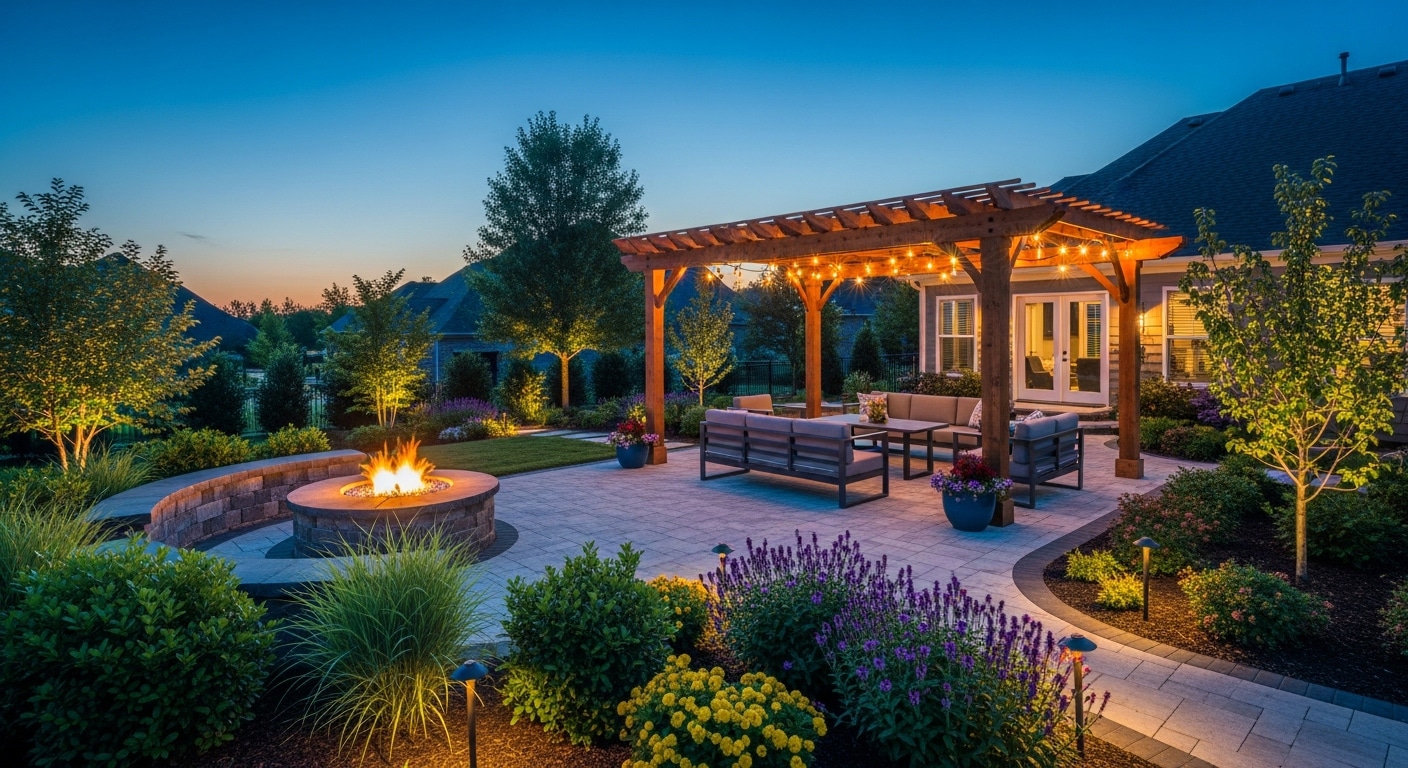
Oklahoma landscapes have a reputation for being difficult — brutal summers, clay soil, periodic drought, and hard freezes all conspire against the generic landscaping advice you find in national home improvement magazines. The ideas that work in Georgia or Oregon often fail spectacularly here. This guide covers landscaping ideas that actually work in Broken Arrow, Tulsa, and the rest of Oklahoma — drawn from the real projects VistaScapes builds every season.
Oklahoma-Proven Landscaping Ideas
1. Create a Defined Outdoor Room
The single most impactful landscaping idea for Oklahoma homes is creating a defined outdoor room — a patio or hardscape area with clear boundaries, overhead shade, and integrated planting. Oklahoma summers make exposed patios unusable by 10am. A shaded outdoor room with a pergola or covered structure, surrounded by appropriately-scaled plantings, becomes a space you actually use daily. The landscape becomes the walls; the pergola becomes the ceiling.
2. Layer Heights for Visual Interest
Flat landscapes with all plants at the same height look monotonous. Layer your plantings: a large shade tree (40–60 ft at maturity) as the canopy layer, mid-size flowering trees or large shrubs (10–20 ft) as the understory, medium shrubs (4–8 ft) as the screening layer, perennials and ornamental grasses (2–4 ft) as the fill layer, and groundcovers and seasonal color at ground level. This tiered approach creates depth, visual interest year-round, and a much more naturalistic appearance.
3. Go Heavy on Native and Adapted Plants
Oklahoma native and adapted plants require dramatically less water, fertilizer, and pest control than non-adapted exotics. Our favorites for Broken Arrow and Tulsa: Oklahoma Redbud, Shumard Oak, Little Bluestem grass, Black-eyed Susan, Purple Coneflower, Liriope, Possumhaw Holly, and Knockout Roses. These plants evolved for or are perfectly adapted to Oklahoma’s clay soil, summer heat, and drought cycles.
4. Build Raised Planting Beds
Oklahoma clay soil is the single biggest obstacle to successful landscaping. Instead of fighting it, raise above it. Raised planting beds with quality amended soil — 8–12 inches above grade — allow you to grow plants that would struggle in native clay. Edged with stone, concrete block, or steel edging, raised beds also define spaces and create visual structure in the landscape.
5. Install Drip Irrigation in All Planting Beds
Spray heads in planting beds waste water through evaporation and overspray. Drip irrigation delivers water directly to plant root zones, reducing water use by 30–50% while improving plant health. Every landscape bed VistaScapes installs includes a drip irrigation zone — it’s the single most important factor in plant establishment and long-term survival during Oklahoma droughts.
6. Use Ornamental Grasses for Movement and Texture
Ornamental grasses are one of the most underused elements in Oklahoma landscapes. They provide movement in the breeze, interesting seed heads through fall and winter, and dramatic textural contrast against broadleaf plants. Top performers: Little Bluestem (native, blue-green turning orange-red in fall), Karl Foerster Feather Reed Grass (upright, architectural), and Muhly Grass (pink fall plumes).
7. Plan for Winter Interest
Oklahoma winters are gray and brown for 3–4 months. Plants that provide winter interest — evergreens for structure and color, ornamental grasses with dried seed heads, hollies with red berries, and trees with interesting bark (Lacebark Elm, Crape Myrtle, River Birch) — keep your landscape looking intentional even in January.
Want to bring these ideas to life at your Broken Arrow or Tulsa property? Call VistaScapes at (918) 779-1317 or request a design consultation. We’ll design a landscape that looks great every season and thrives in Oklahoma’s challenging conditions.