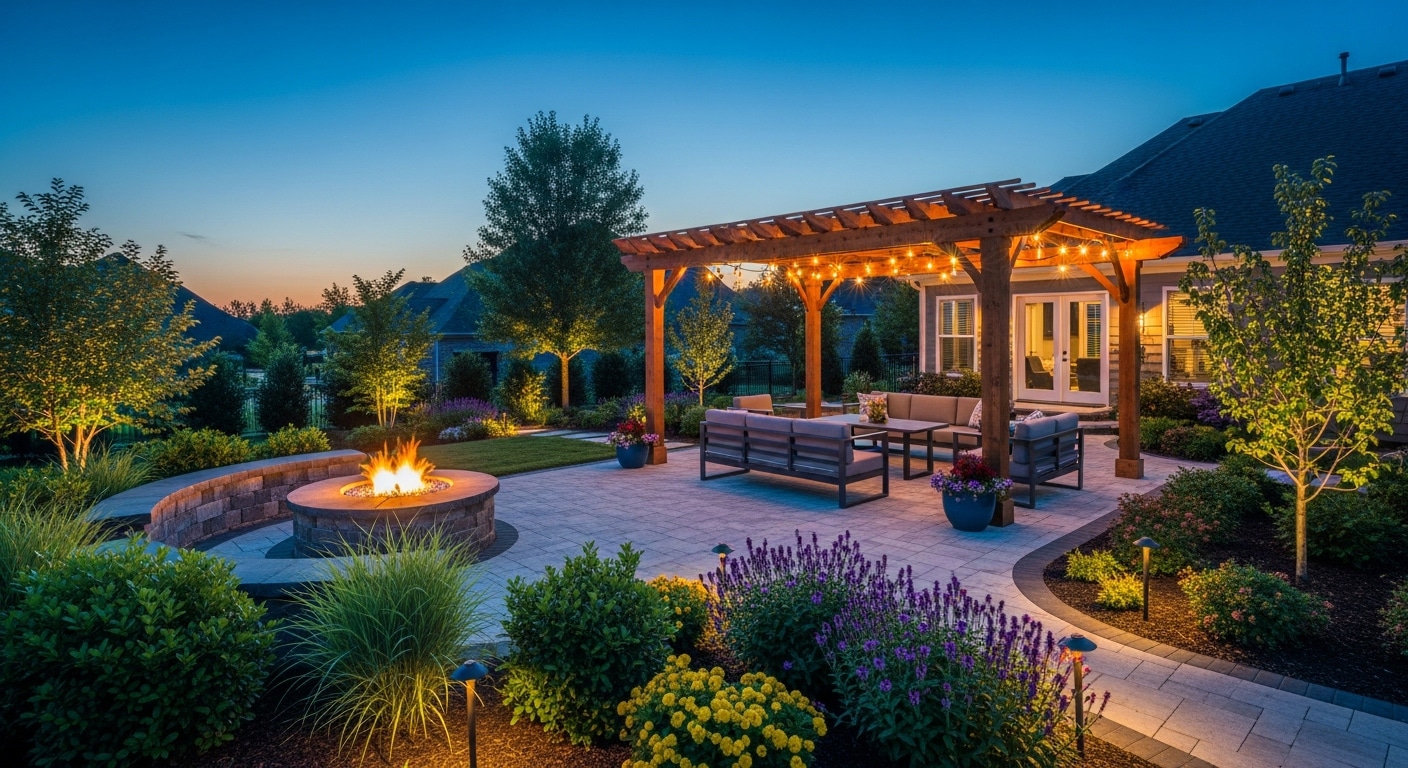
The choice between an attached covered patio — a covered structure that connects directly to the home’s exterior wall — and a freestanding covered patio — a structure with four independent posts set away from the house — is one of the first structural decisions in a Broken Arrow outdoor living project. Both configurations produce functional covered outdoor rooms, but they differ meaningfully in how they connect to the home, how they handle water management at the attachment point, how they integrate with the home’s roofline, and how they affect the home’s resale value. VistaScapes & Design builds both attached and freestanding covered patios in Broken Arrow and evaluates which approach makes more sense for each project based on the site conditions, the homeowner’s goals, and the home’s architectural configuration.
Attached Covered Patios
An attached covered patio connects to the home through a ledger board (for wood-framed residential construction) or a masonry anchor system (for brick homes) at the fascia or eave line of the home’s existing roof. The attached structure shares the home’s wall as one of its structural supports, reducing the number of posts required and integrating the covered patio into the home’s architectural mass rather than placing it as a separate structure in the yard. The primary advantage of the attached configuration: the covered patio feels like a true extension of the home rather than a separate structure — guests moving from inside to outside pass through a continuous sheltered environment rather than crossing an exposed gap. The primary challenge: the connection point between the covered patio roof and the home’s exterior wall must be properly flashed and sealed to prevent water infiltration into the home’s wall cavity. A covered patio ledger or attachment that is improperly flashed produces chronic water intrusion into the home’s wall assembly — VistaScapes & Design uses proper flashing tape, weep screed, and caulk detailing at every attachment point on Broken Arrow covered patio projects.
Freestanding Covered Patios
A freestanding covered patio is structurally independent of the home — four posts set on individual concrete piers, framed with independent headers and rafters, covering an outdoor area that may be directly adjacent to the home’s exterior or set some distance away. Freestanding structures are simpler to install because they require no attachment to the home’s exterior wall and no flashing at a connection point — the structure stands on its own, and water management is handled by the roof’s own slope and drip edge rather than by a wall connection detail. Freestanding covered patios are appropriate when the home’s roof line makes a clean attachment impractical (a low hip roof with complex geometry, for example), when the homeowner wants the covered patio in a position that doesn’t align with the home’s wall, or when the project is a standalone garden structure rather than a home extension. The trade-off: a freestanding patio that sits immediately adjacent to the home but is not attached creates a gap between the covered patio roof and the home’s wall that requires careful weatherstripping or a skirt detail to prevent rain from driving into the gap.
Call VistaScapes & Design at (918) 779-1317 for a free covered patio consultation in Broken Arrow. We’ll evaluate your property’s specific conditions and recommend the attachment approach — attached or freestanding — that produces the best result for your outdoor kitchen and patio project.