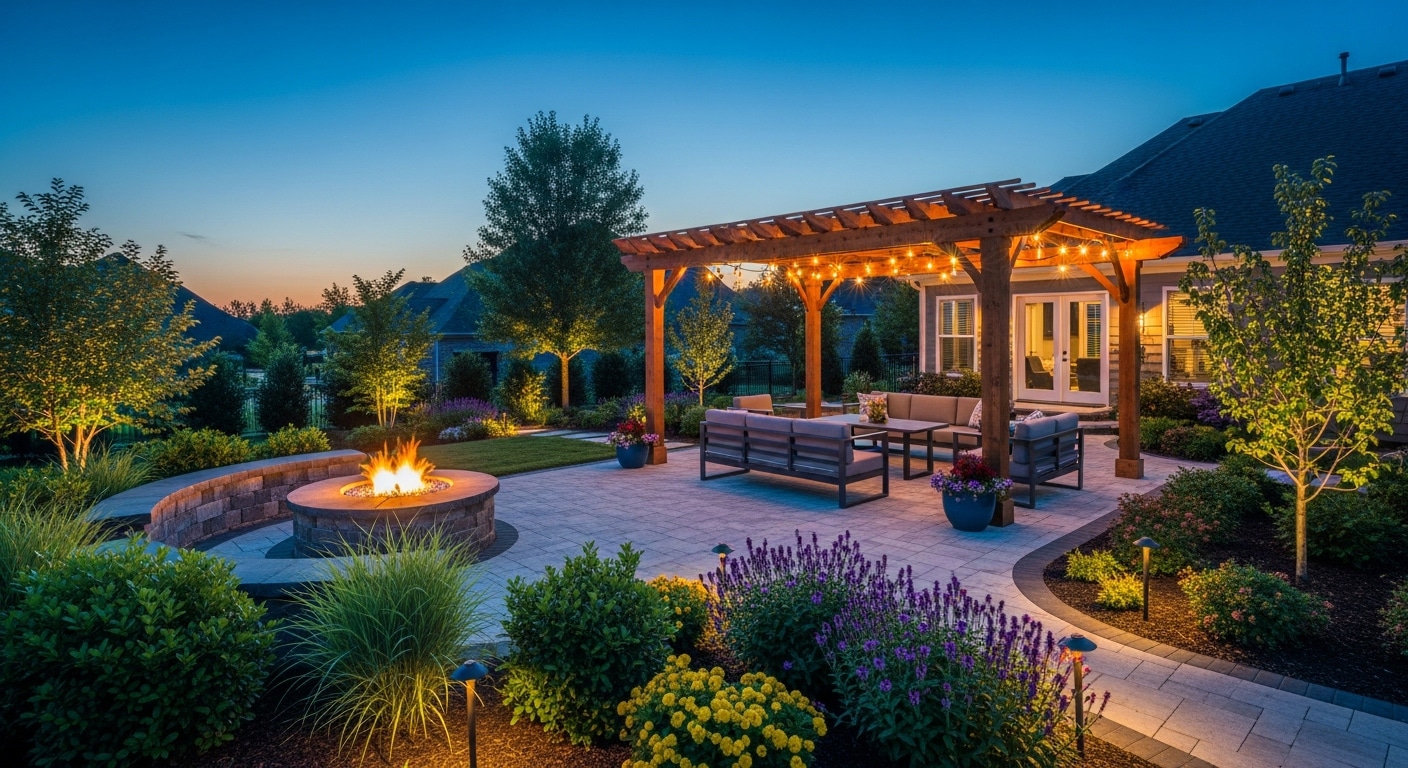
The footing depth for a Broken Arrow masonry outdoor kitchen base and covered patio structural posts must satisfy two engineering requirements: adequate bearing depth into stable, undisturbed soil, and sufficient depth to prevent frost heave from lifting the foundation during freezing weather. Oklahoma’s frost penetration depth — the depth to which the ground freezes during a typical winter — is shallower than in northern states, but Broken Arrow’s expansive clay soil creates a more complex foundation engineering challenge than frost depth alone because the clay soil shrinks and swells significantly with seasonal moisture change. VistaScapes & Design designs and specifies footing depths for every Broken Arrow outdoor kitchen and covered patio project in accordance with the City of Broken Arrow’s building code requirements.
Oklahoma Frost Line and Code Requirements
Oklahoma frost line and building code requirements for Broken Arrow outdoor kitchen footings: Oklahoma frost penetration depth — the International Residential Code (IRC) and the City of Broken Arrow’s building code establish the minimum footing depth for covered patio post footings and structural foundations based on the local frost depth; the frost depth for the Tulsa metropolitan area (which includes Broken Arrow) is designated at 14 to 18 inches below the finished grade in the IRC frost depth map; the City of Broken Arrow’s building department requires covered patio post footings to be a minimum of 18 inches below the finished grade to account for local frost depth variability and soil conditions. Covered patio post footings: the covered patio’s structural posts must be supported on formed concrete pier footings that extend to the required frost depth; a typical Broken Arrow covered patio post footing is a 12-inch diameter by 18 to 24-inch deep poured concrete pier with a minimum of one #4 rebar running the footing’s full depth and projecting into the post base bracket; the footing must bear on undisturbed native soil or properly compacted engineered fill — it cannot bear on topsoil, fill soil, or the organic layer within the top 12 inches of most Broken Arrow residential lots; poured concrete pier footings are required for covered patio structural posts; precast concrete blocks (CMU blocks or concrete deck blocks) are not adequate for covered patio post footings in Broken Arrow. Masonry outdoor kitchen base footing: the masonry outdoor kitchen’s CMU base requires a reinforced concrete footing to distribute the masonry weight into the soil; for a masonry outdoor kitchen on a 4-inch reinforced concrete patio slab, the footing is typically integrated into the slab design as a thickened slab section (6 to 8 inches thick, 12 to 16 inches wide) at the kitchen’s perimeter wall locations; when the outdoor kitchen sits on a separate concrete pad rather than the main patio slab, a continuous spread footing (12 to 16 inches wide, 8 to 12 inches thick) at 18 to 24 inches below grade is required; the City of Broken Arrow’s building department reviews the footing design on the permit drawing submittal.
Expansive Clay Soil Considerations
Expansive clay soil considerations for Broken Arrow outdoor kitchen and covered patio foundations: the engineering challenge of Oklahoma clay — Broken Arrow’s native soil is predominantly expansive clay (Verdigris-type clay loam), which exhibits volumetric change of 3 to 10 percent in response to moisture content changes; when wet, the clay swells; when dry, it shrinks; this moisture cycling produces differential movement in foundations that bear on the clay’s upper moisture-active zone; the upper 3 to 5 feet of clay soil in most Broken Arrow residential lots is within the zone of active moisture cycling (the active zone depth varies based on site drainage, landscaping irrigation, tree root proximity, and local drainage patterns). Footing strategies for expansive clay: the standard approach for Broken Arrow covered patio footings is to extend the pier footings deep enough to engage the stable zone below the moisture-active upper layer; in most Broken Arrow residential lots, a 24-inch deep pier footing reaches the transitional zone between active and stable clay; in lots with significant vegetation (large trees that extract soil moisture) or highly variable drainage, 30 to 36-inch deep footings may be required to achieve adequate bearing in stable soil; drilled concrete piers (also called caissons) of 12 to 18 inches in diameter and 36 to 48 inches in depth are used for larger covered patio structures where the structural loads are higher or where soil conditions require deeper bearing. Post bases and moisture protection: covered patio structural posts in Broken Arrow should be supported on elevated post bases (Simpson Strong-Tie CB, ABU, or equivalent post bases) that hold the post bottom above the concrete footing surface by 1 to 2 inches; this elevation prevents the post from sitting in standing water that accumulates on the footing surface during rain events and extends the post’s service life; all exposed wood structural members in Broken Arrow covered patios should be pressure-treated (PT) lumber with a 0.15 lb/ft³ or higher preservative retention level for above-grade applications. VistaScapes & Design specifies footing depths and dimensions based on the Broken Arrow site’s soil conditions and the City’s building code requirements on every outdoor kitchen and covered patio project.
Call VistaScapes & Design at (918) 779-1317 for a free outdoor kitchen consultation in Broken Arrow. We’ll specify the correct footing depth for your covered patio structure and masonry outdoor kitchen base based on your site’s soil conditions.