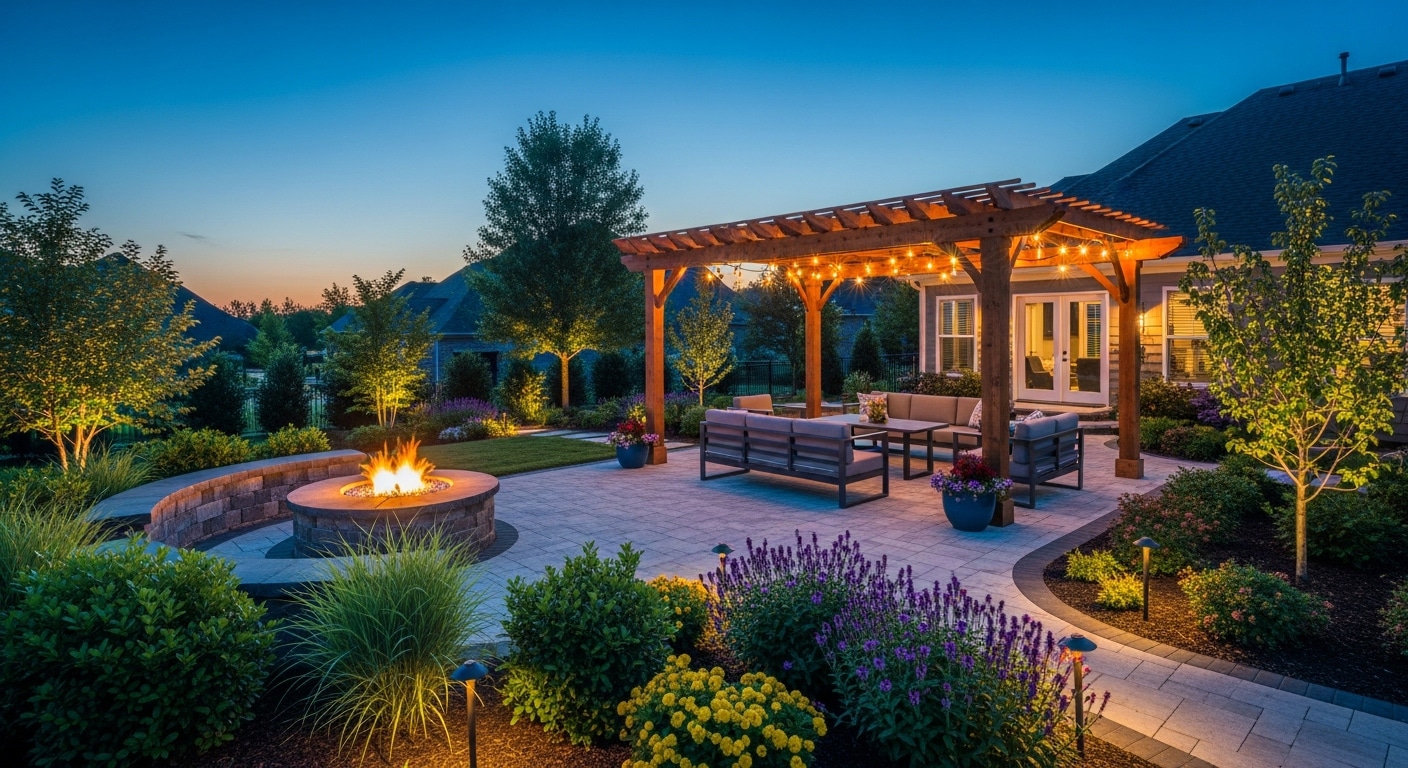
Outdoor Living Material Longevity Comparison — What Lasts Longest in Oklahoma
Oklahoma’s climate is demanding. We get hot summers, cold winters, frequent severe storms, humidity in spring and fall, and the occasional ice storm. The materials you choose for your outdoor living space directly determine how long it lasts, how much maintenance it requires, and how it looks ten years from now.
At VistaScapes & Design, we’ve built outdoor living spaces in Broken Arrow and northeast Oklahoma for years. Here’s an honest comparison of the most common materials we work with — how long they last, what they require, and where they’re worth the investment.
Natural Stone (Flagstone, Oklahoma Limestone, Arkansas Stone, Granite)
Expected lifespan: 50–100+ years
Natural stone is the longest-lasting outdoor material in existence. Oklahoma flagstone, Arkansas ledgestone, and imported granites have been used in construction for centuries because they simply don’t deteriorate under normal conditions. Stone doesn’t rot, doesn’t rust, doesn’t fade, and doesn’t require painting. In Oklahoma’s climate, natural stone handles freeze-thaw cycles, UV exposure, and humidity without significant degradation.
The primary maintenance for natural stone is repointing mortar joints (every 15–25 years depending on exposure) and occasional sealing to reduce staining in high-traffic areas. A natural stone fireplace or patio built correctly will still look excellent 40 years from now.
Best applications: Fireplace facing, fire pit surrounds, patio flagstone, retaining walls, outdoor kitchen veneer
Oklahoma consideration: Oklahoma limestone and Arkansas ledgestone are locally sourced and particularly well-suited to our climate since they’ve been in this region for millennia
Concrete (Poured Slabs, Decorative Finishes, Concrete Block)
Expected lifespan: 30–50 years for slabs; indefinite for block construction
Properly installed concrete is highly durable in Oklahoma’s climate. A 4-inch patio slab with fiber reinforcement, control joints, and a quality sealer will last 30–50 years before requiring major attention. Decorative finishes — stamped, stained, or exposed aggregate — add longevity considerations since the surface treatment requires resealing every 3–5 years to maintain appearance, but the slab beneath remains structurally sound indefinitely.
Concrete block construction — the structural core of most of our outdoor kitchens and fireplace bases — is essentially permanent. Concrete block doesn’t rot, warp, or deteriorate. It’s what we build the framework of most structures on because it provides a stable, moisture-resistant base for decades.
Best applications: Patio slabs, structural cores for fireplaces and kitchens, retaining walls, decorative finishes
Oklahoma consideration: Proper control joints are essential in Oklahoma to manage freeze-thaw cracking; concrete without adequate control joints will crack
Brick
Expected lifespan: 50–100+ years
Fired clay brick is extremely durable and well-suited to Oklahoma’s climate. It handles UV exposure without fading (the color is throughout the brick, not just on the surface), resists moisture absorption better than many materials, and maintains structural integrity indefinitely when properly laid with mortar. Brick fireplaces that were built 70–80 years ago in Tulsa-area homes still function perfectly today.
The primary maintenance is mortar joint repointing every 20–30 years. Brick cleaning may be needed in areas with significant algae growth in moist, shaded locations.
Best applications: Fireplaces, fire pits, outdoor kitchen facing, retaining walls, patio surfaces
Oklahoma consideration: Brick is an excellent choice for fireplaces in Oklahoma because it handles the thermal cycling of repeated heating and cooling without degrading
Cedar Wood
Expected lifespan: 15–25 years with maintenance; 10–15 years without
Western red cedar is the premier outdoor wood for Oklahoma pergolas and covered structures. It naturally resists rot and insect damage better than pine or untreated lumber, and its dimensional stability — resistance to warping and checking — holds up better through Oklahoma’s humidity swings than most other woods.
However, cedar is still wood, and wood requires maintenance in Oklahoma’s climate. Without regular sealing or staining every 2–3 years, cedar will gray, check, and eventually begin to deteriorate. With consistent maintenance, a cedar pergola built properly can look good for 20+ years. Failure to maintain it accelerates deterioration significantly.
Best applications: Pergolas, shade structures, shade sail posts, privacy lattice panels
Oklahoma consideration: Oklahoma’s humidity and temperature swings make maintenance more important here than in drier climates; plan for annual inspection and 2–3 year refinishing cycles
Composite and Aluminum Decking/Pergola Systems
Expected lifespan: 25–50 years with minimal maintenance
Composite decking and aluminum pergola systems have become increasingly popular because they require far less maintenance than wood while lasting significantly longer. Aluminum pergola systems don’t rot, don’t warp, and don’t require painting — the powder coat finish holds up well in Oklahoma’s UV exposure. Composite decking doesn’t splinter, doesn’t require staining, and resists the moisture and insect issues that affect wood.
The trade-off is cost (aluminum and composite systems cost more than wood upfront) and the fact that they don’t have the natural warmth and character of real wood or stone. They’re practical, low-maintenance choices for homeowners who don’t want to deal with annual maintenance tasks.
Best applications: Pergolas, shade structures, decking surfaces
Oklahoma consideration: Aluminum handles Oklahoma’s UV exposure and hail better than wood; it’s a solid choice for the pergola structure even when paired with natural stone or concrete elements
Stainless Steel (Appliances, Hardware)
Expected lifespan: 15–25 years for appliances
Marine-grade stainless steel (304 or 316 grade) is the standard for outdoor kitchen appliances in Oklahoma’s climate. It resists rust and corrosion in our humidity conditions and handles the thermal cycles of outdoor cooking. Lower-grade stainless can still rust, particularly at cut edges and weld points — quality matters here.
Appliance lifespans in outdoor kitchens are limited more by mechanical components (igniters, electronics, seals) than by the stainless shell itself. A quality outdoor grill in Broken Arrow’s climate can last 15–20 years with proper care; budget grills may need replacement in 5–8 years.
VistaScapes Material Recommendation Summary
For maximum longevity with minimal maintenance: natural stone + concrete block structure. This combination — concrete block core with natural stone veneer — is what we use for our fireplaces and outdoor kitchens because it lasts generations without structural issues.
For pergola structures: aluminum over cedar if low-maintenance is your priority; cedar over composite if natural wood character matters most to you and you’re committed to maintenance.
For patios: flagstone on a concrete base for maximum longevity; decorative concrete for cost efficiency with 30+ year structural life.
Ready to build something that lasts? Call VistaScapes & Design at (918) 779-1317 and let’s design a space built for Oklahoma’s climate.