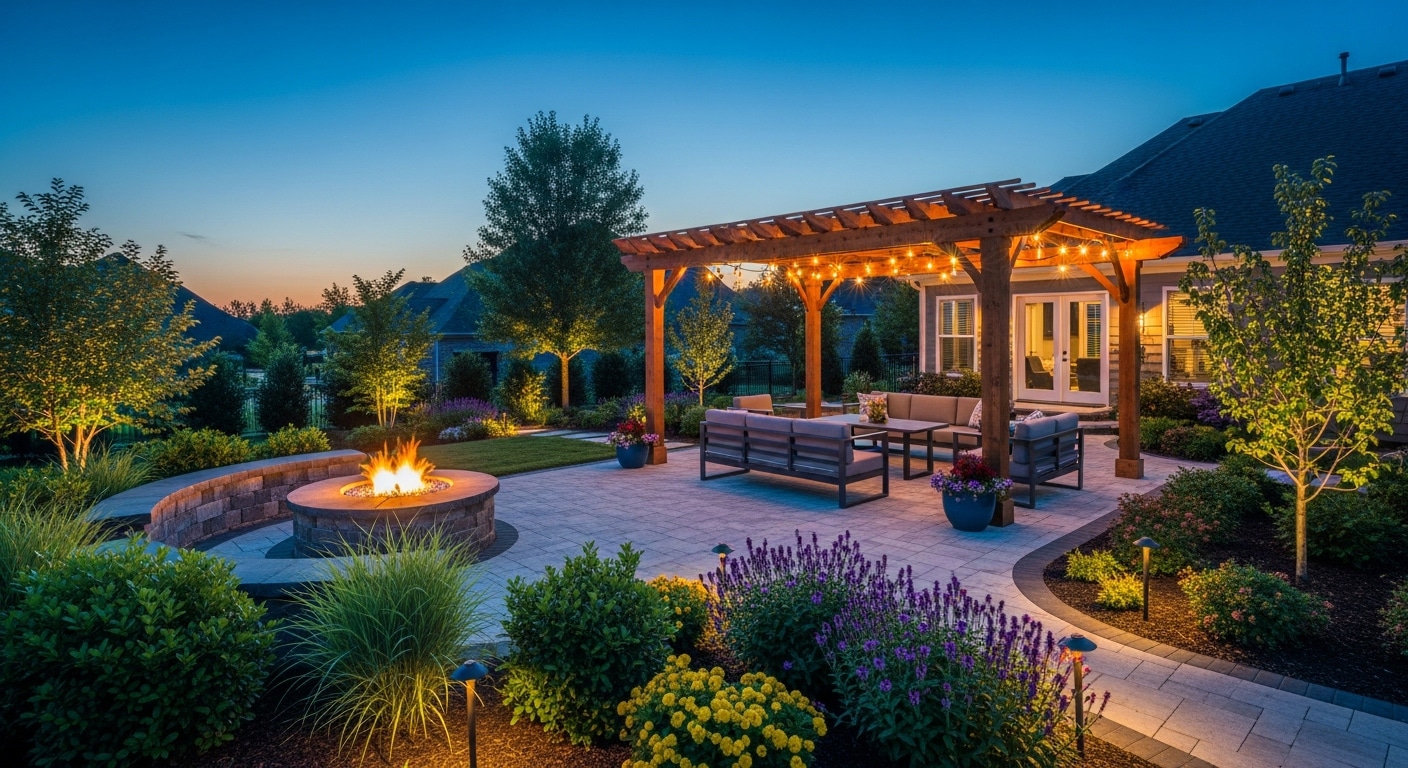
Narrow backyards are common in northeast Oklahoma — particularly in the infill neighborhoods of Tulsa, the townhome sections of Broken Arrow, and the newer subdivision lots where builders stretched the home footprint to the edge of the setback. A 30-foot-wide yard sounds limiting, but with the right design strategy, it can support a covered patio, an outdoor kitchen, and a comfortable seating zone without feeling cramped. The mistake most homeowners make is trying to shrink a typical backyard design rather than rethinking the layout entirely.
Work with the Depth, Not the Width
Narrow yards typically have more depth than width. The design strategy is to create a series of zones along the depth axis rather than trying to fit everything across the narrow width. Think of it as a sequence rather than a plaza: entry zone, dining or kitchen zone, lounge or fire zone. Each zone is shallow but the transition between them creates the experience of a larger, more varied space.
A pergola or covered patio structure that runs the full width of the yard anchors the transition from house to outdoor space and immediately establishes the scale of the space without fighting the constraint. Once you have defined the covered zone, everything beyond it becomes layered outdoor space rather than leftover yard.
Built-In Features That Hug the Perimeter
In narrow yards, built-in features that run along the fence line or property boundary preserve the central open area while still delivering full outdoor living functionality. An outdoor kitchen built flush against the back fence or a side privacy wall uses the boundary as the fourth wall of the kitchen — no wasted space, and the kitchen does not intrude into the usable yard depth.
Similarly, a linear fire feature — a gas fire table or a rectangular fire pit running parallel to the long axis of the yard — fits tightly between two seating walls without consuming the width that a circular fire pit arrangement demands. Long benches along each side wall with a fire feature centered between them creates an outdoor room feel in yards as narrow as 20 to 25 feet.
Vertical Layering as a Design Tool
When horizontal space is limited, vertical elements earn their place. A pergola with climbing plants adds overhead interest without consuming floor area. Tall privacy walls or green screens along the fence line create enclosure and visual texture. A vertical planter wall anchored to a fence post line adds greenery and color without occupying the narrow ground plane.
In northeast Oklahoma where cedar, native climbing vines, and shade plants grow readily, integrating live plants into the vertical plane of a narrow outdoor space is both practical and visually effective. Native crossvine and coral honeysuckle on a pergola or fence trellis look deliberate and finished in a way that purely hard-surfaced walls do not.
Patio Flooring Choice Matters More in Narrow Spaces
Flooring pattern direction has an outsized effect on how narrow outdoor spaces feel. Running pavers or decking boards perpendicular to the long axis of the yard — across the width — makes the space feel wider. Running them along the long axis makes the yard feel deeper and more tunnel-like. For most narrow backyards in Oklahoma, a perpendicular or diagonal paver pattern is the correct choice to counteract the dimensional constraint.
Large format pavers or concrete slabs also make narrow spaces feel more open than small unit pavers — fewer grout lines means less visual choppiness, and the eye reads the surface as more expansive.
What You Can Realistically Fit
In a typical Broken Arrow narrow lot — say 30 feet wide by 50 feet deep — a skilled outdoor living contractor can fit a 12 x 20 foot covered patio with ceiling fan and lighting, a modest built-in outdoor kitchen (grill, two burners, refrigerator, and 8 feet of counter), a dining table for six, and a small lounge zone with a gas fire table. It is not unlimited space, but it is a complete outdoor living experience that most Oklahoma families will use constantly across the outdoor season.
The key is working with a contractor who has designed for constrained lots rather than defaulting to standard layouts. Ask to see portfolio examples of narrow or smaller backyard projects specifically — designers who have solved this problem know the tricks that matter.