Tulsa Landscaping Ideas for 2025
Tulsa’s landscaping scene has evolved significantly — homeowners are moving away from high-maintenance traditional lawns and toward designed outdoor environments that are beautiful, functional, and better adapted to northeast Oklahoma’s demanding climate. Here’s what’s trending in Tulsa landscaping in 2025 and why these ideas work so well for Oklahoma properties.
Native & Adaptive Plant Designs
The single biggest shift in Tulsa landscaping in 2025 is the move toward native and adaptive plant species. After experiencing several extremely hot, dry summers in recent years, Tulsa homeowners have learned that traditional foundation plantings and turf-heavy landscapes require enormous water inputs and constant replacement of plants that simply aren’t suited for Oklahoma’s climate.
Native Oklahoma plants — Little Bluestem grass, Black-eyed Susan, Purple Coneflower, Spiderwort, Buttonbush, and native Salvia species — are beautiful, support pollinators, need minimal supplemental irrigation once established, and have evolved specifically to thrive in Tulsa’s soil and climate conditions.
Mixed Ornamental Grass & Perennial Borders
The prairie-inspired planting style — combining ornamental grasses with flowering perennials in naturalistic, layered drifts — has become one of Tulsa’s most popular landscaping aesthetics. It’s low-maintenance, beautiful across multiple seasons (not just spring bloom), and looks intentional and designed rather than neglected. Muhly grass, Switchgrass, and Little Bluestem provide movement and winter texture while coneflowers, black-eyed susans, and salvias provide season-long color.
Hardscape-Heavy, Lawn-Light Designs
Tulsa homeowners are increasingly replacing high-maintenance lawn areas with expanded patio surfaces, gravel garden rooms, stepping stone paths through planting areas, and mulched garden beds. These designs reduce weekly mowing, irrigation demand, and chemical inputs while creating more visually interesting outdoor environments. The result is a yard that looks better with less effort — particularly appealing as homeowners’ time for yard work decreases.
Productive & Edible Landscape Elements
Incorporating productive plants into ornamental landscapes has become increasingly popular in Tulsa. Raised kitchen garden beds built from cedar, brick, or concrete block — positioned near the back door or patio for easy access — are being requested alongside ornamental elements rather than hidden in a back corner. Dwarf fruit trees, berry bushes, and herb gardens are being integrated into landscape designs as both functional and attractive elements.
Layered Landscape Lighting
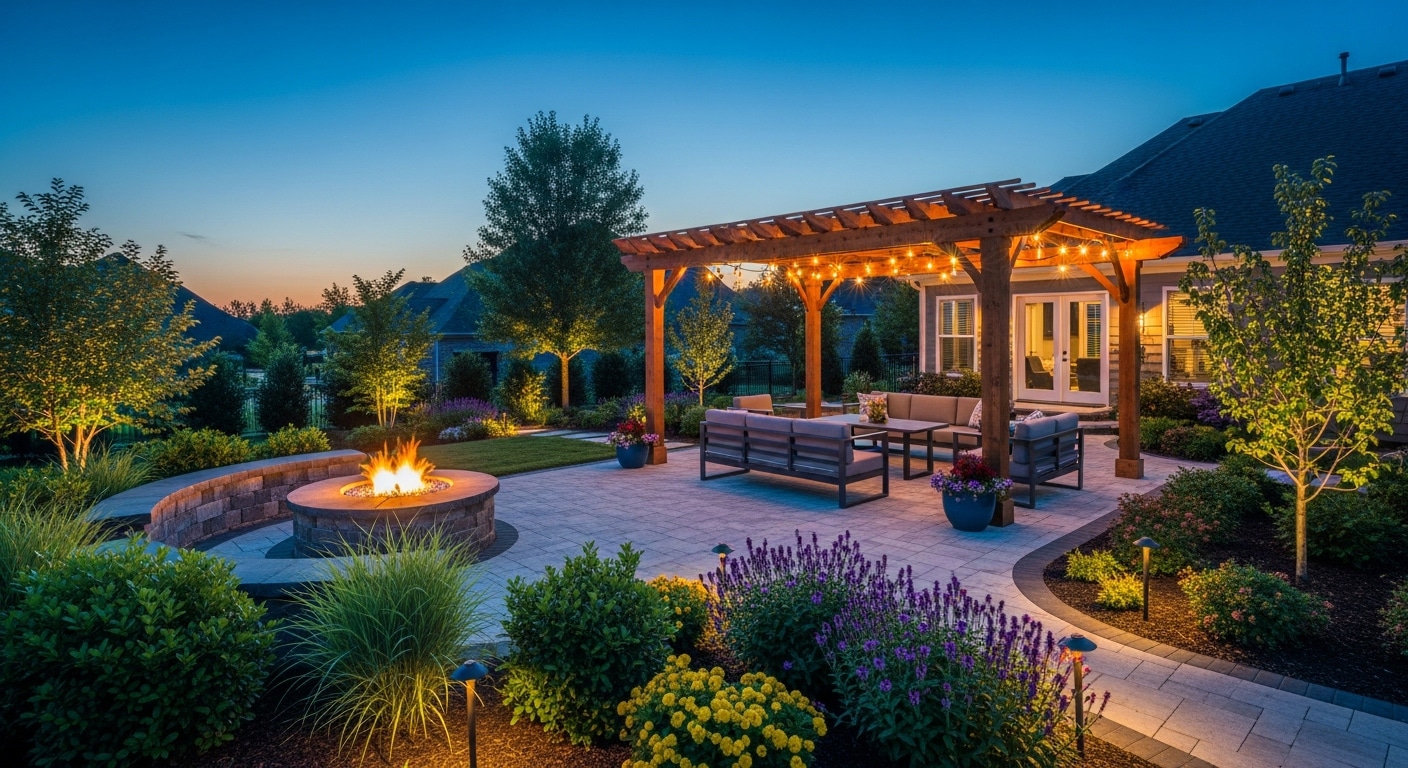
Landscape lighting in Tulsa has moved from an afterthought to a design priority. Property owners who have seen professionally lit landscapes at night understand immediately that the experience of being in an outdoor space at night is completely transformed by thoughtful lighting. Tulsa landscapes in 2025 are being designed with multiple lighting layers — uplighting for trees and architectural features, path lighting for navigation, downlighting from pergolas for ambient dining light, and accent lighting for focal plants and garden structures.
Low-Water Lawn Alternatives
Some Tulsa homeowners are eliminating traditional turf entirely in certain zones, replacing it with decomposed granite, pea gravel, or flagstone paths through low-water ground covers. These areas eliminate mowing and irrigation in that zone entirely. Other homeowners are replacing high-water fescue lawns with drought-tolerant Bermuda or Zoysia that, once established, require significantly less irrigation to maintain healthy appearance through July and August.
Transform Your Tulsa Landscape With VistaScapes
Call VistaScapes Design at 918-779-1317 to discuss your Tulsa landscaping project. We design and install complete landscape transformations throughout the Tulsa metro that are beautiful today and built to thrive for decades in northeast Oklahoma’s challenging climate.