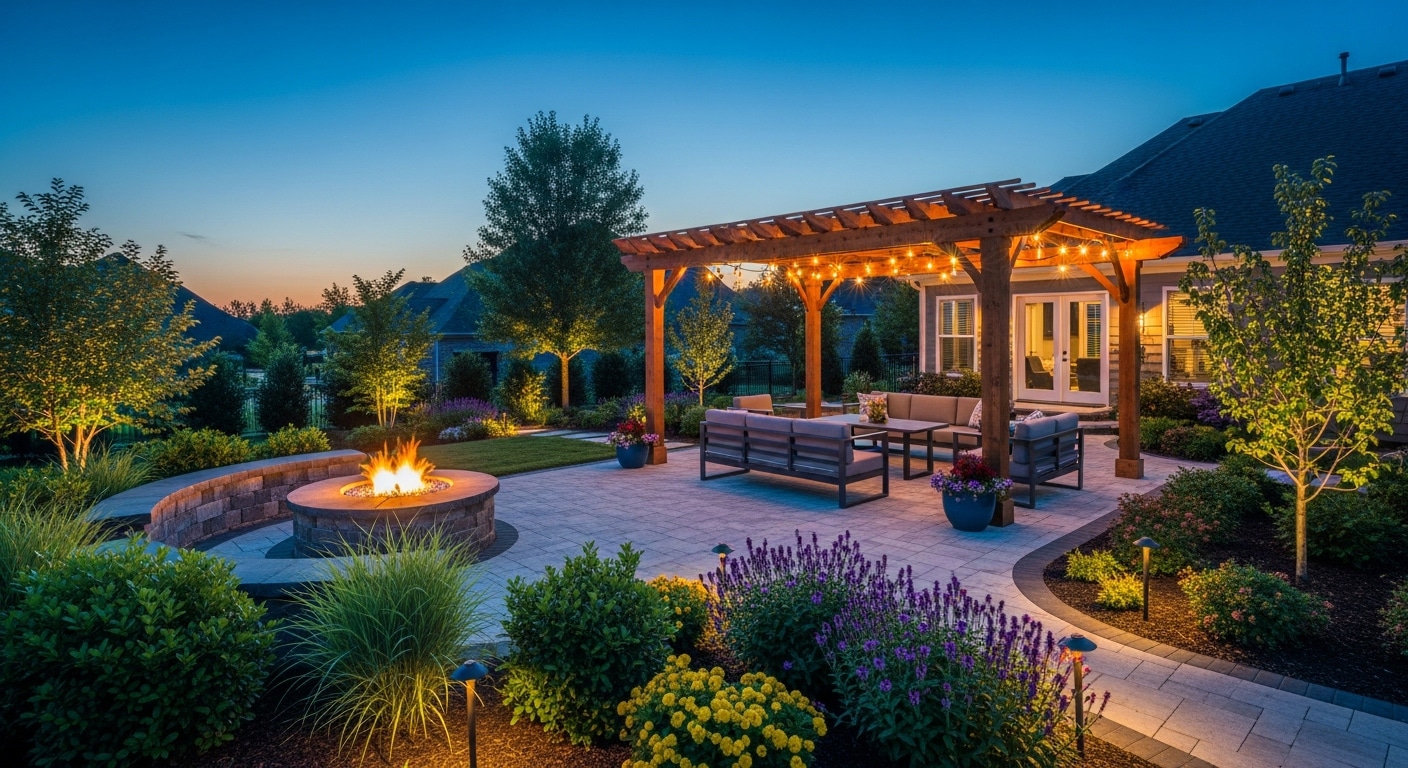
Drainage management for a Broken Arrow covered patio and outdoor kitchen encompasses two distinct systems that must work together: the roof drainage system (gutters and downspouts that collect and discharge rainwater from the covered patio’s roof) and the slab drainage system (the slope and drainage path built into the concrete slab that directs water away from the covered patio’s structure and the home’s foundation). Oklahoma’s climate — characterized by intense convective thunderstorms that can deliver 2 to 4 inches of rain in a one-hour period — places a high demand on both systems, and an inadequately designed drainage plan produces a covered patio that pools water on the slab, saturates the adjacent landscape, directs water toward the home’s foundation, or creates drainage conflicts with the existing lot drainage pattern. VistaScapes & Design designs both the roof drainage and slab drainage systems for every Broken Arrow covered patio project.
Roof Drainage: Gutters and Downspouts
Gutter and downspout systems for Broken Arrow covered patios: gutter size selection — standard 5-inch K-style aluminum gutters are adequate for covered patio roof areas up to approximately 600 square feet with a single downspout; for larger covered patios (16 by 24 feet = 384 square feet of roof area, 20 by 28 feet = 560 square feet), 6-inch K-style gutters provide additional capacity for Oklahoma’s intense rain events and reduce the risk of gutter overflow during peak storm intensity; 6-inch gutters are recommended on any Broken Arrow covered patio where the roof drainage discharges toward the home, a paved surface, or a landscape planting area. Gutter pitch: gutters must slope toward the downspout at a minimum of 1/16-inch per foot of run (equivalent to a 1/4-inch drop over 4 feet of horizontal gutter run); insufficient pitch causes gutters to pond water, which accelerates corrosion of aluminum gutters and provides standing water for mosquito breeding; excessive pitch (greater than 1/4-inch per foot) makes the low end of the gutter hang visually below the fascia and creates an aesthetically awkward profile. Downspout sizing and placement: a single 2-inch by 3-inch rectangular downspout handles the drainage from approximately 600 square feet of roof area in Oklahoma’s design rainfall intensity; 3-inch by 4-inch rectangular downspouts are recommended for covered patio roof areas exceeding 600 square feet or in locations where the downspout is the sole drainage outlet for the entire roof; downspout placement should direct discharge away from the home’s foundation (minimum 6 feet from the foundation wall), away from the outdoor kitchen’s masonry base (staining from gutter overflow degrades stone and stucco veneer), and toward a drainage swale, lawn area, or underground drain that carries runoff away from the covered patio and home. Gutter guard selection: covered patio gutters accumulate debris from adjacent trees, roofing granules from the shingles, and insect material; micro-mesh gutter guards (Leaf Filter, LeafGuard, Raptor) keep the gutter clean without requiring seasonal cleanings; solid gutter covers are less effective in high-debris environments; for covered patios under or adjacent to large trees in Broken Arrow, micro-mesh gutter guards are a worthwhile upgrade that prevents clogged downspouts during the heavy leaf-fall periods.
Slab Drainage and Surface Slope
Slab drainage and surface slope for Broken Arrow covered patio concrete: concrete slab slope — a covered patio concrete slab must slope away from the home’s foundation wall at a minimum of 1/8-inch per foot (1 percent slope) to prevent water from ponding against the foundation; the standard specification for outdoor concrete slabs is 1/4-inch per foot (2 percent slope) away from the home, which provides a visible and effective drainage path during rainfall and hose-down cleaning; a 2 percent slope over a 16-foot-deep patio produces a 4-inch differential in elevation between the slab’s high point at the home and the slab’s low point at the patio’s outer edge; this differential is not visually perceptible as a slope but is effective at draining surface water. Slab drainage direction: the covered patio slab’s slope should direct water toward a surface or subsurface drainage path — the slope should run toward the lawn, a planting bed, or a drainage swale; a concrete apron, step landing, or hardscape transition directly adjacent to the slab’s low edge should also slope away from the covered patio to continue the drainage path; drainage that terminates at a flat lawn area with heavy clay soil (common in eastern Broken Arrow) can produce ponding at the patio’s edge — in these cases, a French drain (perforated pipe in a gravel trench) installed along the patio’s low edge collects and carries away the runoff. Outdoor kitchen drainage: the outdoor kitchen’s masonry base sits on the covered patio slab and its immediate perimeter receives water from cooking (grill grease, sink splash, ice from the refrigerator’s ice-maker drain); the outdoor kitchen’s sink drain must be connected to a drain line that carries the wastewater away from the slab — either to the home’s drain system (requiring a licensed plumber) or to a dry well (a gravel-filled pit that disperses water into the soil); water that drains from the outdoor kitchen sink onto the concrete slab can create a persistent damp area that encourages algae growth and makes the slab slippery; a drain-connected sink prevents this problem. Slab joint sealing: the construction joints (control joints and expansion joints) in the covered patio slab must be sealed with a backer rod and polyurethane sealant to prevent water infiltration through the joints; unsealed joints allow water to enter the soil below the slab, which can produce slab movement in Broken Arrow’s expansive clay soils. VistaScapes & Design specifies 1/4-inch per foot slab slope, downspout discharge locations, and sink drain connections on every Broken Arrow covered patio and outdoor kitchen project.
Call VistaScapes & Design at (918) 779-1317 for a free covered patio consultation in Broken Arrow. We’ll design the roof drainage, slab slope, and outdoor kitchen drain connections for your covered patio project.