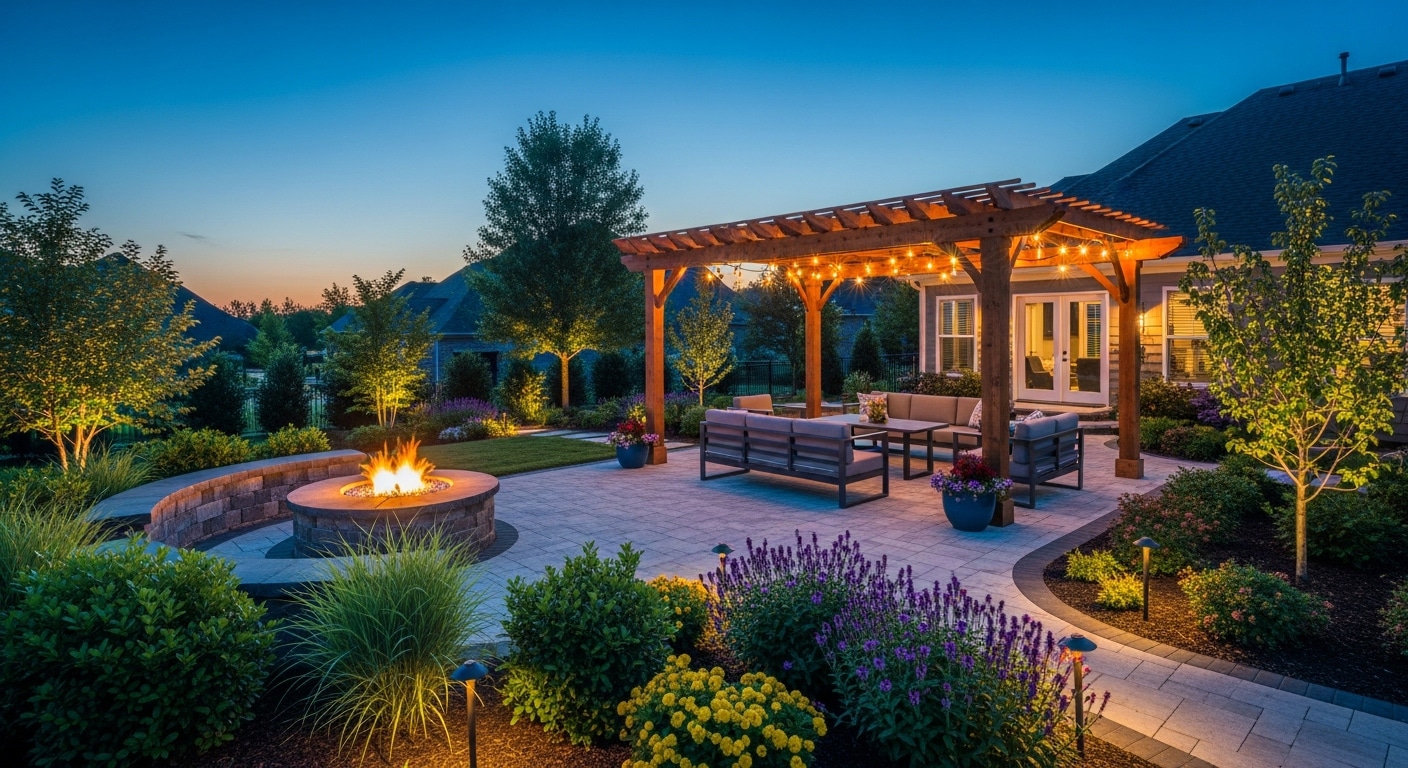
The question of whether to install a vent hood over the built-in grill in a Broken Arrow masonry outdoor kitchen covered patio generates more uncertainty among homeowners and contractors alike than almost any other outdoor kitchen specification decision. The confusion arises because the rules governing outdoor kitchen hood ventilation differ fundamentally from the rules governing indoor kitchen range hood ventilation — and because the correct answer depends on the specific covered patio configuration, the grill’s BTU output, and the local code’s interpretation of “outdoor” versus “semi-enclosed” cooking environments. VistaScapes & Design addresses the hood ventilation question at every Broken Arrow outdoor kitchen consultation and designs the covered patio ventilation configuration to meet both code requirements and the homeowner’s comfort preferences.
When a Hood Is Required vs Optional
Hood ventilation requirements for Broken Arrow outdoor kitchens under covered patios: an outdoor kitchen under a fully open pergola structure (open sides, no walls, lattice or open-beam roof) is classified as an outdoor cooking appliance by the National Fuel Gas Code and most local codes and does not require a vent hood; the open-sided structure provides sufficient natural ventilation to prevent the accumulation of combustion gases. A masonry outdoor kitchen under an attached covered patio with a solid roof (shingles, metal, or solid decking) and at least two open sides also typically does not require a vent hood per the NFGC — the two open sides provide cross-ventilation and the combustion gases from the grill dissipate naturally in the outdoor environment. A covered patio or outdoor kitchen enclosure that approaches a semi-enclosed configuration — more than two walls, glass panels or screens on multiple sides, a low ceiling height under 8 feet, or a configuration where the cooking zone is recessed into a covered alcove — may require mechanical ventilation depending on the local code interpretation and the building official’s review. The City of Broken Arrow development services department interprets the ventilation requirements based on the percentage of open perimeter relative to total perimeter — a covered patio with more than 50% of the perimeter open to the outdoors is generally classified as an outdoor cooking environment and does not require a vent hood; a covered structure that is more than 50% enclosed requires mechanical ventilation review. For large BTU grills (over 60,000 BTU/hr combined grill output) in a covered patio environment, installing a vent hood is recommended even when not strictly required by code — the hood captures smoke, grease aerosols, and combustion byproducts that would otherwise collect in the covered patio space and coat the ceiling, soffit, and structural elements with grease residue over time.
Outdoor Hood Types and Specifications
Outdoor vent hood types for Broken Arrow covered patio outdoor kitchens: outdoor-rated island hoods — wall-mount or ceiling-mount stainless steel hoods designed for outdoor installation in covered patio environments; outdoor-rated hoods are constructed from heavier-gauge stainless than indoor residential hoods and use sealed motors, sealed electrical components, and stainless baffles that can withstand Oklahoma’s outdoor humidity and temperature cycling; outdoor hood brands appropriate for Broken Arrow covered patio kitchens include Proline Range Hoods (outdoor series), Vent-A-Hood (outdoor), Cavaliere, and custom fabricated stainless hoods from local sheet metal shops. Hood sizing for outdoor kitchens: the hood should extend at least 6 inches beyond the grill’s width on each side and 6 inches beyond the grill’s depth at the front; for a 36-inch built-in grill in a Broken Arrow outdoor kitchen, the minimum hood width is 48 inches; for a 42-inch grill, the minimum hood width is 54 inches; the hood depth (front to back) should cover the full depth of the grill cooking surface. CFM requirements for outdoor hoods: outdoor vent hoods require higher CFM ratings than comparable indoor hoods because the outdoor environment has more ambient air movement that dilutes the hood’s capture velocity — outdoor kitchen hood airflow recommendations are 100 to 200 CFM per linear foot of grill width; for a 36-inch grill under a Broken Arrow covered patio, a 600 to 900 CFM outdoor-rated hood blower is appropriate; for a 48-inch or 54-inch grill, 900 to 1,200 CFM is recommended. Ductwork: an outdoor vent hood must exhaust to the exterior — an outdoor kitchen hood under a covered patio typically vents upward through the patio roof and terminates with a weatherproof roof cap; the duct must be 6-inch round or equivalent rectangular duct in stainless or galvanized steel; the duct run should be as short and straight as possible to maximize airflow efficiency. VistaScapes & Design designs the hood and ductwork routing at the covered patio framing stage to ensure the hood can be properly ducted to the exterior without excessive duct run length.
Call VistaScapes & Design at (918) 779-1317 for a free outdoor kitchen consultation in Broken Arrow. We’ll design the ventilation configuration for your covered patio outdoor kitchen and specify the correct hood type if one is required.